
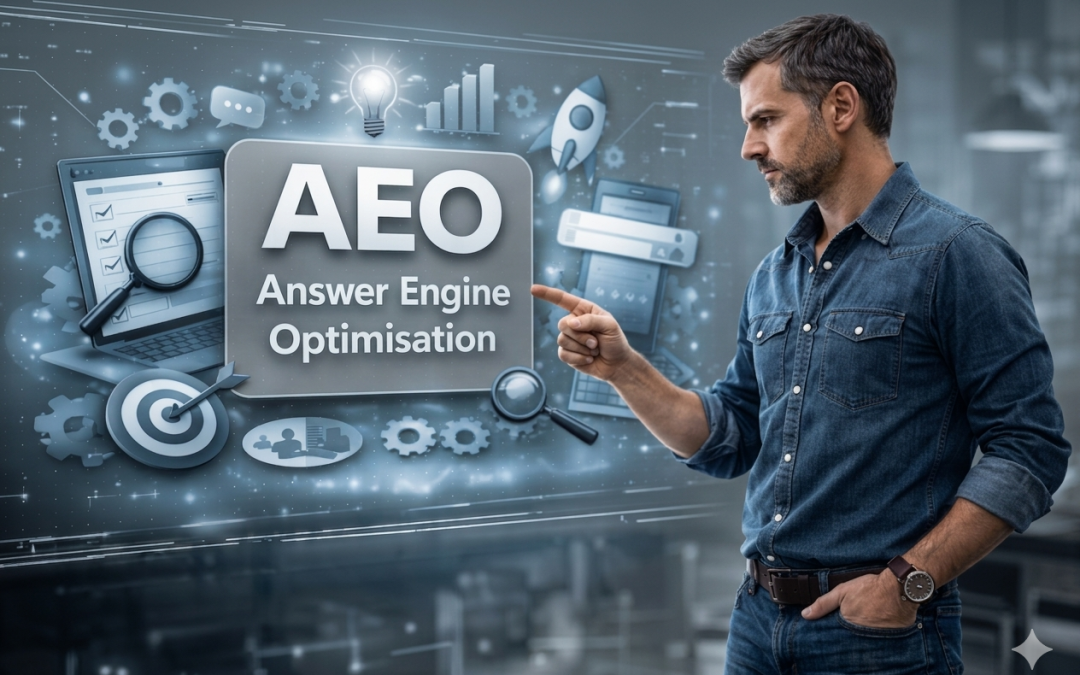
The Question Has Changed
Most SMEs still ask: “How do we rank higher on Google?”
The businesses pulling ahead are asking something different: “How do we become the answer?”
That shift is what Answer Engine Optimisation (AEO) is about. Search has evolved from a list of blue links into an answer machine -Google AI Overviews, voice assistants, ChatGPT, Perplexity. These platforms don’t return websites. They return a response. And that response comes from whoever communicated most clearly.
New Lead - Extreme Marketing
What Is AEO?
AEO is the practice of structuring your content, so search engines and AI platforms can confidently surface your business as the direct answer to a question.
Where SEO asks: “How do we get ranked?” AEO asks: “How do we get chosen?”
It’s not a replacement for SEO. It’s the same foundations but with sharper focus.
Why SMEs Have the Advantage
AEO doesn’t favour big budgets. It favours clarity.
Large brands produce broad, generic content designed to appeal to everyone. SMEs live inside their customers’ problems, you know the objections, the real questions, the nuance. That specificity is exactly what answer engines reward.
The challenge isn’t having the knowledge. It’s translating it into content that AI systems can recognise and trust.
Where Most SMEs Fall Short
The gap is rarely effort – it’s alignment. Common issues:
- Service pages that describe, not answer – Prospects have specific questions. Most pages don’t address them.
- Keywords over intent – Ranking for “accounting services” doesn’t mean you’re answering, “what should a small business look for in an accountant?”
- No extractable structure – No clear Q&A format, no schema markup, nothing an AI can cleanly pull and cite.
The expertise exists. It’s just not organised in a way search systems can work with.
What AEO-Ready Content Looks Like
Ask yourself: If someone put this question to an AI, would my page be a satisfying answer?
The format that gets cited:
- Question-led headings – mirrors how users actually search
- Direct 2–3 sentence answer – immediately after the heading
- Supporting depth – context and expertise that builds authority
- FAQ or How-To schema – tells search engines exactly what type of content this is
Where to Start AEO
One exercise that works every time:
Write down the 20 questions your prospects ask most before they buy. Then check if your website actually answers them directly, clearly, in plain language.
In most cases, it doesn’t. Those answers exist in your team’s heads, your sales calls, your onboarding docs. AEO is the process of surfacing that knowledge into structured, public-facing content.
The AEO Payoff
When your business is consistently cited by AI tools and appears as a trusted voice in your niche, credibility compounds. Users arrive with higher intent. Trust is established before the first conversation.
No ad budget can replicate that.
The businesses winning in AI-driven search aren’t the biggest. They’re the clearest.
Wondering if your website is AEO-ready?
AEO FAQs for SMEs
What is AEO?
Answer Engine Optimisation (AEO) is about making your content easy for Google, AI tools, and voice assistants to use as the answer. Instead of just trying to rank higher, you’re making sure your business gets chosen when someone asks a question.
How is AEO different from SEO?
SEO helps your website show up in search results. AEO goes one step further , it helps your business be the direct answer those search engines and AI tools display. Think of SEO as getting seen and AEO as getting picked.
Why should SMEs care about AEO?
SMEs have the advantage because you know your customers’ real questions. Big brands often publish generic content, but SMEs can give specific, clear answers. That’s exactly what AI tools reward.
How can I start making my site AEO‑ready?
Write down questions your customers ask before buying. Then check if your website answers them directly, in plain language, with clear headings and short answers. Add supporting detail and use FAQ or How‑To formats so search engines can easily cite you.