

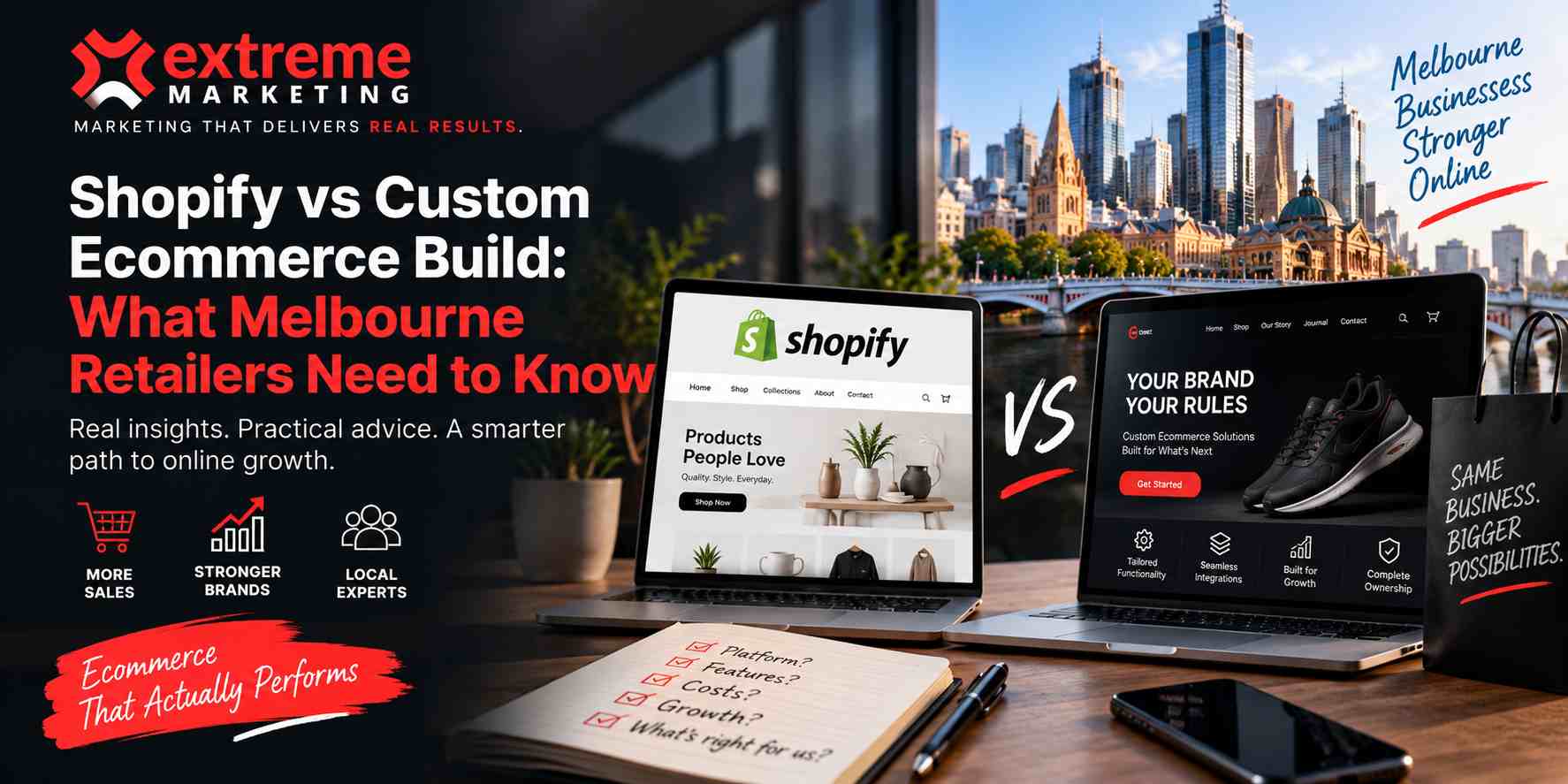
If you run a retail business and want to sell more online, the platform underneath your store matters.
No one gets a medal for picking the most complicated setup.
You also don’t win by picking Shopify just because everyone else does.
The right choice balances speed, control, cost, and growth for your business.
For most retailers, that means weighing up Shopify against a custom build before you spend a cent.
The short answer
Shopify is your fast track if you want an online store live quickly, with hosting, checkout, product management, payments, and a huge app ecosystem ready to go.
Custom ecommerce makes sense when your workflows, customer experience, or integrations just don’t fit the standard mould.
Neither option is automatically better. Your business model calls the shots.
What is Shopify website development?
Shopify website development means building an online store on the Shopify platform. The platform provides the underlying e-commerce infrastructure, while a developer or design team shapes the storefront, navigation, product experience, integrations, and conversion journey.
Shopify plans in Australia start at $42 AUD per month (billed yearly) for Basic. Shopify Plus, aimed at complex businesses, starts at $3,700 AUD per month on a three-year term. Prices move, so check Shopify Australia for the latest before you budget.
For current plan pricing and feature limits, see Shopify Australia pricing.
Why Melbourne retailers choose Shopify
Speed is the main drawcard.
You skip building hosting, product management, checkout, and the core commerce engine from scratch.
Shopify also supports online and in-person selling, product management, multiple sales channels, inventory management, and a large app ecosystem. Shopify Payments is available in Australia and supports card payments, accelerated checkout methods, and selected local payment methods.
Shopify lists current payment options here: Shopify Payments in Australia.
For a retailer opening an online store, this can remove much of the technical work before the first sale.
Where Shopify can save time
- Store setup
- Product and inventory management
- Checkout
- Hosting
- Security infrastructure
- Payment processing
- Sales via multiple channels
- Connections to third-party apps
Where a custom ecommerce build starts to make sense
Custom ecommerce gets interesting when your sales model breaks the standard retail mould.
Maybe your pricing depends on complicated customer rules.
Maybe customers need a tailored ordering journey.
Maybe your stock system, wholesale operation, or internal workflow needs to connect in a very specific way.
Or perhaps the customer experience itself is the competitive advantage.
In these cases, forcing your business to fit the platform just creates extra work.
Examples of custom requirements
- Complex product configuration
- Customer-specific pricing
- Wholesale ordering workflows
- Custom account areas
- Unusual subscription schemes
- Complex stock rules
- Specialised integrations
- Unique checkout or ordering processes
- Custom reporting requirements
- Multiple business systems that need to exchange data
Shopify versus custom ecommerce: the practical comparison
| Business need | Shopify | Custom build |
| Launch quickly | Strong fit | Usually more planning |
| Standard retail store | Strong fit | May be unnecessary |
| Unique customer journey | Possible with development | Strong fit |
| Complex integrations | Possible | Strong fit |
| Control over underlying system | Platform dependent | Greater control |
| Ongoing platform simplicity | Strong fit | More responsibility |
| Highly specialised workflows | Can require workarounds | Strong fit |
| Budget predictability | Subscription plus development and apps | Depends on scope and maintenance |
The cost question retailers should actually ask
If you only look at the upfront invoice, you’ll miss the real cost difference between Shopify and custom ecommerce.
Shopify has a recurring platform cost. You may also spend money on themes, apps, development, payment processing, and specialist work.
A custom build can require a larger initial investment because the software is being designed around your business. It also needs hosting, maintenance, security updates and future development.
The real question isn’t which one is cheaper.
Ask which option gets you the result you want for the lowest sensible cost.
Do not pay for custom development just to be different
This is where ecommerce projects start burning cash for no good reason.
If Shopify already does what you need, rebuilding it from scratch won’t magically add value.
A custom build should have a reason.
Perhaps it gives customers a better buying experience.
Perhaps it removes a costly manual process.
Perhaps it connects systems that otherwise do not work together.
Perhaps it lets the business operate in a way a standard platform cannot support.
If you can’t explain the commercial reason for going custom, pause and clarify what you actually need.
Do not force your business into Shopify either
The flip side is just as common.
A retailer starts with Shopify because it’s familiar, then piles on apps and workarounds until the store is a headache to manage.
One app handles customer pricing.
Another handles subscriptions.
Another handles stock.
Another handles product configuration.
Another connects the accounting system.
Sooner or later, the question shifts from ‘Can Shopify do this?’ to ‘How much is this stack costing us to keep running?’
That’s when it’s time for a proper ecommerce architecture review.
What about design?
Shopify doesn’t mean your store has to look like every other Shopify store.
A good design and dev team can build a storefront that fits your brand, your products, and your customers.
The real question is how far your design needs to break from standard ecommerce patterns.
If your customers want a familiar shopping experience, keep navigation and checkout simple. There’s value in not reinventing the wheel.
If your product needs a totally different journey, custom development can pay for itself.
Shopify web design agency or custom development team?
This is another place to look past the job title.
You want a partner who gets both the tech and the commercial goal.
A real conversation covers conversion, product discovery, mobile shopping, checkout friction, customer retention, search visibility, and the systems running the store.
Extreme Marketing builds websites around real outcomes, not vanity numbers. We tie every project to traffic, bookings, leads, or revenue, and keep reporting straightforward.
For more on the wider website service, see Custom Website Development.
For ecommerce-focused marketing support, see Ecommerce Marketing.
What Melbourne retailers should check before choosing
- How complicated is the product catalogue?
- Do you sell direct to consumers, businesses, or both?
- Do customers need accounts?
- Do different customers receive different pricing?
- How complicated is fulfilment?
- What stock systems are already in place?
- Which accounting and payment systems need to connect?
- Do you need subscriptions or recurring orders?
- How important is a completely custom customer journey?
- What needs to happen automatically after a customer places an order?
A simple decision framework
Pick Shopify when your core needs are covered, and you want a strong store live fast, without building the whole commerce engine yourself.
Go custom when your business model, customer journey, or operations need something more specialised.
There’s also a third option.
Start with Shopify, prove your commercial model, and only invest in custom features when the numbers say you need them.
That’s a smart path for a growing retailer who wants to dodge a big upfront tech bill.
The decision should come back to growth
Your ecommerce platform isn’t the goal.
More profitable online sales are the goal.
The right platform helps you move the numbers that matter.
- Conversion rate
- Average order value
- Repeat purchase rate
- Cost to acquire a customer
- Cart recovery
- Gross margin
- Revenue per customer
- Working time saved
If a platform gives you what you need and helps you lift those numbers, that’s enough.
If tIf your platform is holding back a key part of the business, it’s time to look at custom development.
Frequently Asked Questions
Is Shopify better than a custom ecommerce website?
There is no universal answer. Shopify can suit retailers that want established ecommerce infrastructure and a fast route to market. Custom ecommerce can fit businesses with specialised workflows or customer experiences.
How much does Shopify website development cost in Australia?
The Shopify platform has a recurring subscription cost, while design, development, themes, apps and integrations can add to the total. The final project cost depends on what the retailer wants changed or built.
When should a retailer choose custom ecommerce?
Custom ecommerce is worth investigating when important business requirements cannot be handled cleanly by the chosen platform or when custom functionality creates a clear commercial advantage.
Can Shopify handle a growing Melbourne retail business?
Yes. Shopify offers plans and features created for businesses at different stages, including online and in-person selling, inventory management, multiple sales channels and more advanced options for larger businesses. Check current plan features and pricing directly with Shopify.
Can a Shopify store be customised?
Yes. Shopify supports theme customisation, apps and development through its platform tools. The level of checkout and platform customisation depends on the Shopify plan and your specific requirements.
Should I move from Shopify to a custom ecommerce platform?
Only if there is a clear business reason. Before deciding, review the cost of your current setup, the limitations you are experiencing, and the value a custom solution would create.
The right ecommerce platform is the one that fits the business
Shopify isn’t a shortcut for businesses that don’t know what they need.
Custom ecommerce isn’t automatically the premium choice.
Both can be the right answer.
The judgment comes down to how your customers buy, how your team works, and what the business needs to hit in the next few years.
For a Melbourne retailer, that’s a much better starting point than asking which platform is most popular.
Start with the customer journey.
Map the operational requirements.
Put a number on the outcome you want.
Then pick the technology that gives you the clearest path to that result.

Web & App Development Lead
Mark combines strong technical expertise with a sharp eye for design. With more than five years of experience in website and application development, he has led a wide range of successful digital projects—turning ideas into websites and applications that look great, work smoothly, and support real business goals.


