Marketing automation sounds like something designed for companies with enormous databases, complicated CRM systems and a marketing department the size of a football team.
It does not have to be.
For a small business, marketing automation can be as simple as:
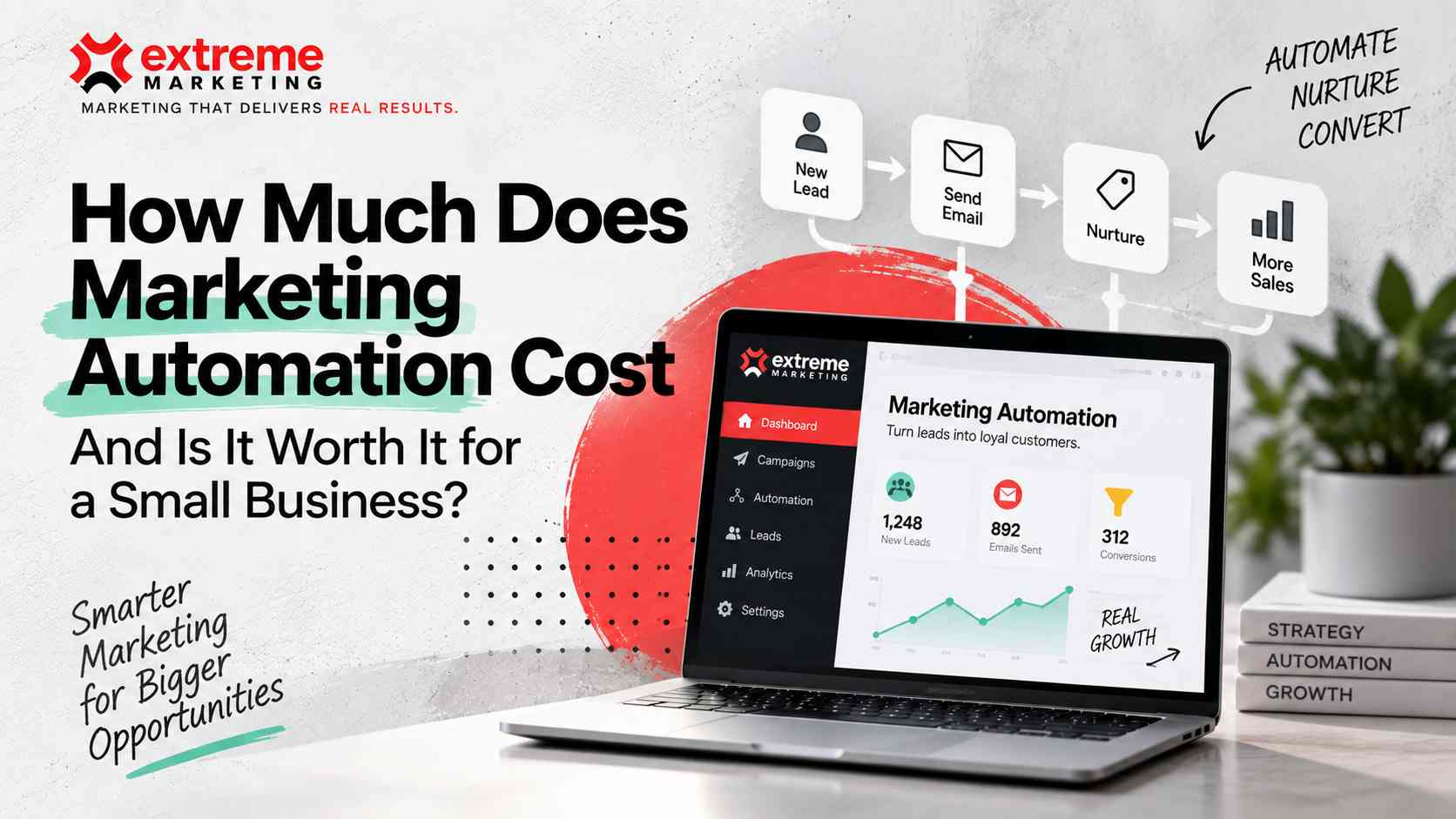
Someone fills in a form → they receive an email → the business follows up → the lead gets moved into the next stage.
That alone can save time.
The real question is not whether automation is possible.
It is whether automating the right parts of your marketing can save enough time, improve follow up and generate enough extra business to justify the cost.
H2: What is marketing automation?
Marketing automation uses software to handle repetitive marketing tasks based on rules, triggers or customer actions.
For example, someone might:
Download a guide
Submit an enquiry
Join an email list
Book a consultation
Visit a specific page
Make a purchase
That action can trigger a follow up.
Instead of someone remembering to send the next email manually, the system handles it.
The same principle can be applied to lead nurturing, customer follow up, abandoned enquiries, onboarding and re engagement.
H2: How much does marketing automation cost?
There is no single price because the cost depends heavily on what you are trying to automate.
For a small business, think about four separate costs:
Software
Initial setup
Strategy and funnel design
Ongoing management and optimisation
A simple automation using an existing email platform may require only a modest software subscription and some setup time.
A more advanced system involving CRM integration, lead scoring, multiple customer journeys, landing pages and reporting can become a much larger project.
That is why asking only, ‘How much does marketing automation cost?’ can produce a misleading answer.
The better question is:
How much does the automation need to do?
H2: The software is only part of the cost
It is easy to focus on the monthly platform fee.
But software is often not the biggest cost.
You also need to consider:
Planning the customer journey
Writing the emails
Building landing pages
Connecting systems
Creating forms
Testing the automation
Tracking results
Maintaining the workflow
A $100 per month platform does not automatically create a successful automation system.
The strategy sitting behind it is what makes the technology useful.
H2: A simple example
Imagine a Melbourne service business receiving 40 enquiries a month.
The team manually responds to every enquiry.
Some people reply.
Some need more information.
Some are not ready yet.
Some disappear completely.
A simple automated sequence could send useful information after the initial enquiry, follow up after a few days and remind the prospect to get back in touch.
The team still handles the important conversations.
The automation simply makes sure potential customers do not fall through the cracks.
H2: Where automation can make the biggest difference
H3: Lead follow up
Speed matters.
If a potential customer submits an enquiry and hears nothing for two days, the opportunity may already be colder.
Automation can acknowledge the enquiry immediately and keep the conversation moving until a person takes over.
H3: Email nurturing
Not everyone is ready to buy immediately.
A useful email sequence can educate potential customers and keep your business visible while they decide.
H3: Customer onboarding
Automation is not only for acquiring customers.
You can also automate welcome emails, instructions, reminders, follow up and other parts of the customer experience.
H3: Re engagement
Some customers simply stop responding.
A carefully designed re engagement sequence can give them a reason to return without your team manually chasing every person.
H2: When marketing automation is probably worth considering
Automation is worth investigating when your team is repeatedly doing the same marketing tasks.
Following up leads manually
Sending the same emails repeatedly
Copying information between systems
Chasing prospects who have gone quiet
Managing large contact lists
Sending appointment reminders
Nurturing leads over several weeks
The more repetitive the process, the more potential there is for automation to save time.
H2: When automation is not the answer
Automation is not automatically useful just because software can do it.
If you only receive a handful of highly personal enquiries each month, manually following up may make more sense.
If the customer journey is still changing, building complicated automation too early can create unnecessary work.
And if the underlying offer is not converting, adding more automation will not magically fix it.
You need a working marketing process before you start scaling it.
H2: Marketing automation and sales funnels work together
Automation works best when the customer journey has been thought through.
That is where sales funnel design becomes important.
A basic funnel might look like:
Traffic → Landing page → Enquiry → Follow up → Sales conversation → Customer
Automation can support different parts of that journey.
The landing page captures the lead.
The form collects the information.
The email sequence provides follow up.
The CRM records the interaction.
The sales team takes over when human contact is needed.
Good automation connects those steps instead of creating another disconnected marketing tool.
H2: What should you measure?
The purpose of automation is not to create more emails.
It is to create better business outcomes.
Lead response time
Email engagement
Qualified enquiries
Appointments
Conversion rate
Sales generated
Cost per lead
Revenue influenced by the automation
Time saved by the team
If an automated workflow saves five hours a week and generates additional qualified enquiries, you can start putting a real value against the investment.
H2: How to calculate whether it is worth it
Start with the problem.
Suppose your business spends 10 hours every week manually following up leads.
That is roughly 40 hours a month.
Now consider what those hours are worth to the business.
Then look at the additional revenue that better follow up could generate.
The calculation becomes much more useful than simply comparing software subscriptions.
You are comparing the cost of automation with the cost of continuing to do the work manually and the value of the opportunities you may currently be missing.
H2: Start small
You do not need to automate the entire business on day one.
Pick one repetitive process.
Map it.
Automate it.
Measure it.
Improve it.
Then decide what should come next.
A small automation that works is much more valuable than a huge automation project nobody understands.
H2: FAQs
How much does marketing automation cost for a small business?
Costs vary depending on software, setup, integrations, funnel complexity and ongoing management. Simple workflows can be relatively inexpensive, while more advanced systems require a larger investment.
Is marketing automation worth it for small businesses?
It can be, particularly when a business has repetitive follow up, lead nurturing or customer communication that takes significant time or causes opportunities to be missed.
What can a small business automate?
Lead follow up, email sequences, customer onboarding, reminders, re engagement and other repetitive communication are common starting points.
Does marketing automation replace sales staff?
Usually, the goal is to support sales staff by handling repetitive tasks and keeping leads moving until human interaction is needed.
What is sales funnel design?
Sales funnel design maps the stages a potential customer moves through from first interaction to enquiry, purchase and sometimes repeat business.
Should a small business automate everything?
No. Start with a repetitive process where automation can create a clear benefit, then expand based on measurable results.
H2: Automation should make your marketing easier, not more complicated
The best automation is often invisible to the customer.
They receive the right message at the right time.
Your team knows what needs attention.
Leads do not get forgotten.
And the business spends less time repeating tasks that software can handle.
That is the real opportunity.
Not more technology for the sake of technology.
A marketing system that helps a small business follow up better, save time and turn more opportunities into customers.

Marketing Lead
Hyzent brings more than 10 years of diverse digital marketing experience to strategy and execution. Her expertise spans SEO, GEO and AI search, funnels, paid advertising, email marketing, CRM, websites, and content. She has developed and implemented successful campaigns across multiple channels, connecting the pieces into strategies focused on measurable growth.